
Key Takeaways
- The labor market is slowing, not collapsing. Despite growing concerns surrounding AI and layoffs, recent employment data continues to reflect a labor market that is evolving unevenly across industries rather than entering broad-based deterioration
- AI disruption remains highly sector-specific. While technology and corporate roles have experienced increased layoffs and hiring slowdowns, areas such as health care, infrastructure, and skilled trades continue to benefit from strong long-term demand trends
- Investors should avoid overreacting to headlines. Technological change has historically created periods of uncertainty, but labor markets and economies tend to adapt gradually over time, reinforcing the importance of maintaining a disciplined long-term investment perspective
Last Friday’s nonfarm payrolls report offered another reminder that the U.S. labor market remains more resilient than many headlines suggest. Employers added 115,000 jobs in April, well above expectations for roughly 65,000, while the unemployment rate held steady at 4.3%. Combined with March, the economy has now added roughly 300,000 jobs over the last two months, marking the first back-to-back monthly gains in nearly a year and quickly shifting the narrative from a big decline posted in February.
The monthly payroll picture has also become increasingly uneven, as shown in the chart below. Job growth has remained positive overall, but the pace of hiring has become far more volatile over the last two years.
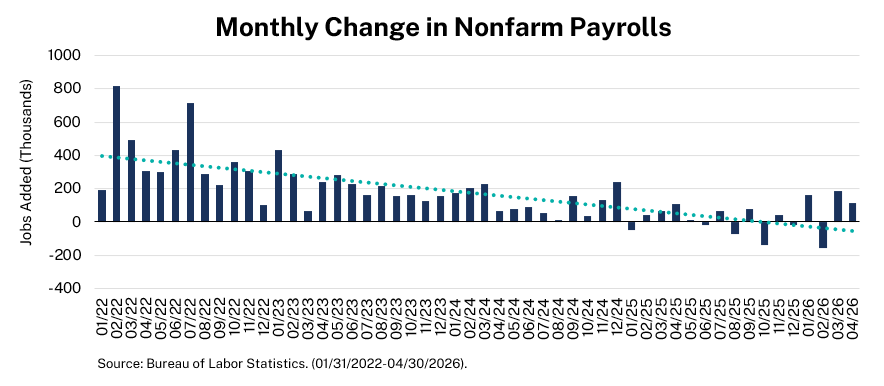
At the same time, the supply of labor’s growth rate may also be lower than it was in prior cycles. Several Federal Reserve studies have noted that slower immigration and an aging population are reducing labor force growth, meaning fewer monthly job gains are now required to keep unemployment stable. Softer payroll numbers today may therefore not carry the same signal of economic weakness that they once did.
Even with the recent improvement in payroll growth, the broader conversation surrounding the labor market remains heavily focused on downside risks. Nearly every week seems to bring another headline warning that AI will significantly disrupt white-collar employment, eliminate entry-level work, or permanently impair the labor market.
Concerns surrounding AI and employment have been amplified by a growing wave of select and concentrated but high-profile layoff announcements. For example, earlier this year fintech firm Block drew significant attention after announcing plans to reduce roughly 40% of its workforce as part of broader efforts to improve efficiency and increase AI investment.
There is important context to keep in mind, however, around many of today’s labor market dynamics. Technology companies broadly and dramatically ramped up hiring during and immediately following the COVID era as digital demand surged and companies invested aggressively for growth. As growth normalized and the operating environment became more challenging, some degree of workforce rationalization was likely inevitable. In many cases, current layoffs appear to reflect a combination of post-pandemic right-sizing, slower corporate spending, margin pressure, and shifting investment priorities alongside AI adoption itself.
An interesting degree of bifurcation has crept into certain aspects of the labor picture as well, with one example shown in the chart below. Health care and private education employment has continued to trend steadily higher, while hiring across the Information sector, often viewed as a proxy for technology and AI-related employment, has slowed following its strong post-pandemic ramp up. Related, software engineering and technology-related job postings also declined meaningfully after surging during the COVID period, though more recent data suggests hiring activity in the sector has begun to stabilize and gradually improve.
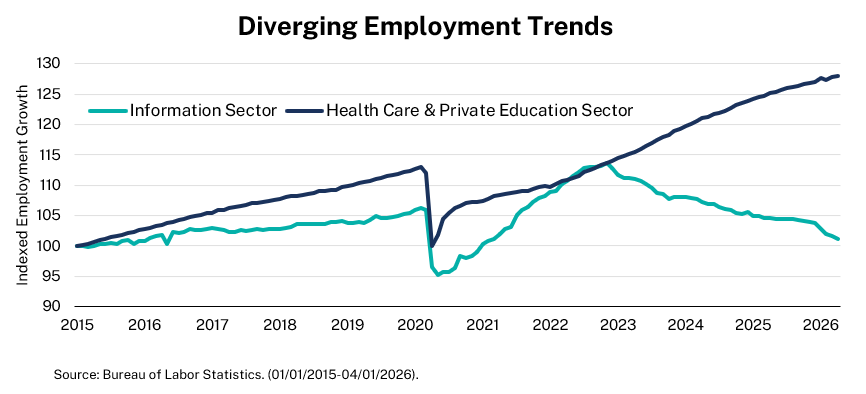
The continued strength in health care employment reflects powerful long-term demographic trends, particularly an aging population that continues to support demand for medical services and care-related roles. Meanwhile, investment in the build-out of computing infrastructure to support the demand for AI is itself creating demand elsewhere in the economy, including skilled trades, manufacturing, semiconductor production, and data center construction. Business formation activity has also remained relatively healthy in recent years, with new business applications continuing to run above pre-pandemic levels. Part of that strength may reflect how AI is both lowering barriers to starting new businesses and becoming the foundation for a growing number of software, automation, and AI-enabled service companies.
Ultimately, the true degree of AI adoption and related labor implications is yet to be seen and impossible to predict. To that end, an April 2026 Yale Budget Lab analysis concluded that AI’s labor market impact so far “largely reflects stability, not major disruption at an economy-wide level.” Technological change has time and again reshaped the labor market throughout history, and AI will likely usher in a similarly uneven transition. Some roles and industries may face meaningful disruption, but history suggests labor markets adapt gradually over time. In managing client portfolios, we take both the risks and opportunities surrounding AI seriously, while also avoiding the temptation to overreact to every headline predicting widespread job loss or industry obsolescence. The labor market of the future will almost certainly look different from today’s, but the evidence so far suggests it is evolving, not disappearing.
This material contains the opinions of Manning & Napier Advisors, LLC, which are subject to change based on evolving market and economic conditions. This material has been distributed for informational purposes only and should not be considered as investment advice or a recommendation of any particular security, strategy, or investment product. Information contained herein has been obtained from sources believed to be reliable, but not guaranteed.